
How to Get Your Sales Team to Hit Their Numbers Without Micromanaging
Many sales managers fall into the same trap.
The pressure to hit the number increases, performance starts slipping, and the instinctive response is to become more hands-on. More check-ins. More reporting. More oversight.
Before long, managers find themselves reviewing every call, every proposal, and every step in the pipeline.
It feels like management.
But most of the time, it’s just micromanagement.
And it usually makes the problem worse.
Good salespeople want to perform. They want autonomy, trust, and the space to work their accounts in the way that suits them best. When managers start hovering over every move, the best people disengage and the weaker performers become dependent.
The goal isn’t to control your sales team. It’s not even to push them. The goal is to have a clear process in place that points your team in the right direction and creates an environment where they are self-motivated.
The goal is to create an environment where strong performance becomes the norm.
Here are a few ways to do that.
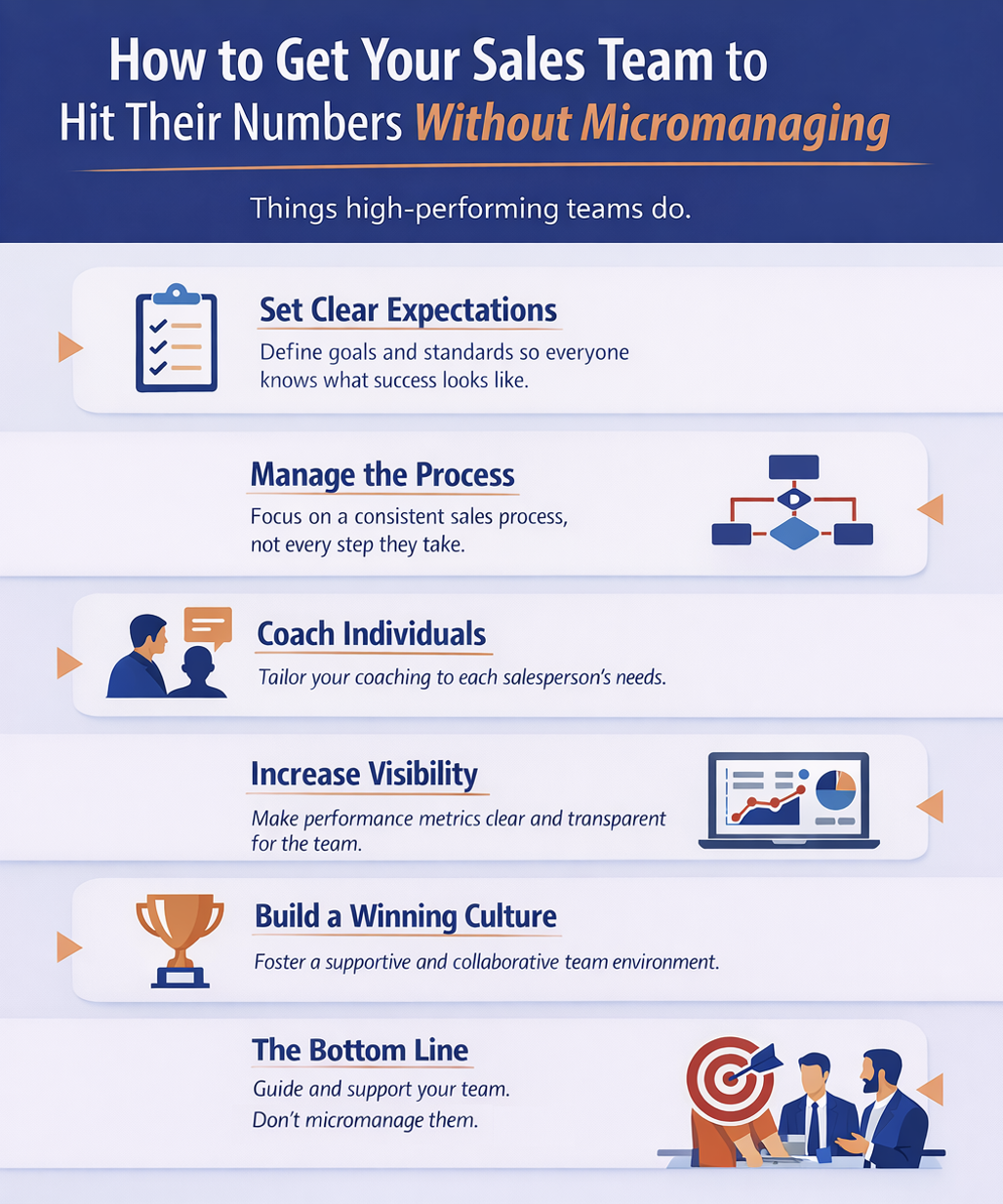
Set Clear Expectations, Not Constant Oversight
Many managers micromanage because expectations were never clearly defined in the first place.
If your team knows exactly what success looks like, they don’t need constant supervision.
Clear expectations include things like:
Pipeline targets
Activity levels that lead to results
Sales process milestones
Follow-up standards with prospects and clients
When expectations are clear and consistent, managers can spend less time policing activity and more time supporting performance.
Manage the Process, Not Every Action
A healthy sales organization runs on a repeatable process.
Managers who feel the need to oversee every step usually don’t have a clear or consistent sales process in place.
Instead of watching every move your salespeople make, focus on whether they are following the process that leads to results.
For example:
Are discovery conversations thorough?
Are opportunities being tracked?
Are next steps clearly defined with the customer?
Is follow-up happening properly?
When the process is strong, the day-to-day decisions can remain with the salesperson.
Coach Individuals, Don’t Manage Everyone the Same Way
One of the fastest ways to create frustration on a sales team is to manage everyone identically.
Your top performers usually need very little oversight. What they want is occasional strategic conversation and the freedom to execute.
Newer or struggling salespeople may need more structure and guidance.
Great managers adjust their approach depending on the individual.
Instead of increasing pressure across the entire team, focus coaching where it actually makes a difference.
Create Real Accountability Through Visibility
Accountability doesn’t come from constant reminders.
It comes from transparency.
When performance metrics are visible to everyone on the team, peer pressure and personal pride often do more than a manager’s oversight ever could.
Simple dashboards showing pipeline health, conversion rates, and closed revenue allow managers to focus conversations on results rather than activity reports.
Foster an environment of support and team wins, not just individual results.
Build a Culture That People Want to Perform In
Sales teams perform best when the environment supports them.
That means:
Open and safe communication with leadership
Managers who listen as well as direct
Recognition of strong performance
A culture where people want to win together
When a team feels supported and respected, managers don’t need to push nearly as hard.
People naturally raise their level of effort.
The Bottom Line
Micromanagement is usually a symptom of something else: unclear expectations, weak processes, or a lack of trust within the team.
When those issues are addressed, most sales teams require far less oversight than managers expect.
Strong sales leadership isn’t about controlling every move.
It’s about creating the structure, clarity, and culture that allow good salespeople to succeed without someone looking over their shoulder.